

Ruway
ruway · ROO-wye · /ˈɾu.waj/ · Quechua
- verb. To do, to make, to build, to work. And also to operate, when it comes to machines.
- imperative. Do it! The same word tells someone to go ahead and do it.
- noun. The act of doing, the action.
From the same root: ruwaq, “the one who does”; ruwasqa, “what has been done”.
We picked a name that says what we do: put robots to work on real jobs. “Robots that work” is the same idea, in other words.
We come from artificial intelligence
Before robots, we built conversational AI for companies in Latin America: agents that serve and sell over WhatsApp, chat and voice, connected to each business's systems and running in production every day.
That's where we learned what it takes for a machine to be useful in a business: it has to speak the language of the business, connect to the systems people already use, follow clear rules about what it does on its own and when it hands off to a person, and everything has to be measurable.
Now we're adding a body. We integrate quadruped and humanoid robots that bring that intelligence to an event, a plant, a site or a store.
Conversation in production
Scripts, voice and knowledge bases that answer with your business information and hand off to a person when a question goes off topic.
Integration with your systems
The robot sends its data where you already work: your CRM, your alarms, your maintenance system or your spreadsheets.
Responsible operation
In writing: what's autonomous and what isn't, data on your network and facial recognition off by default.
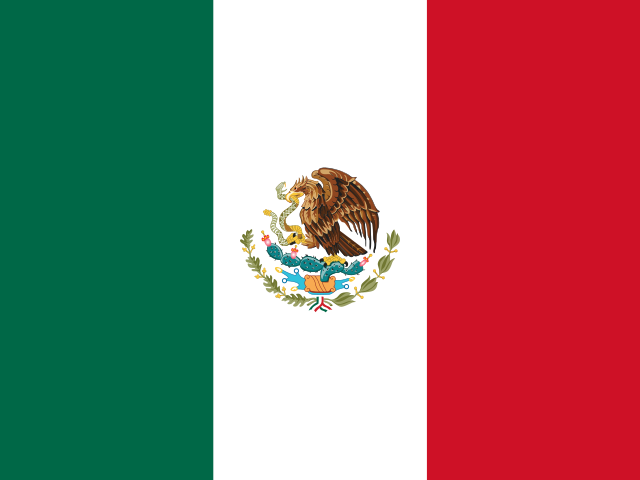
We're based in Buenos Aires and deploy in the US and eight Latin American countries.
Who the Quechua are
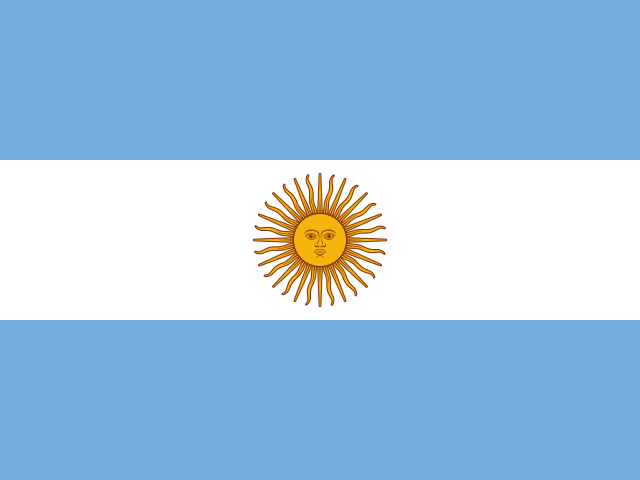
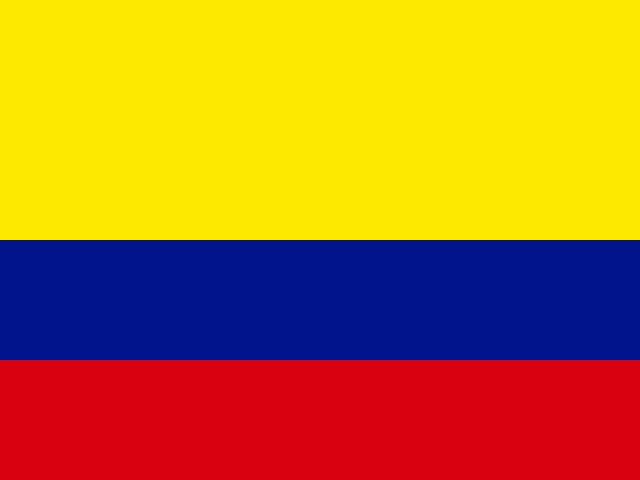
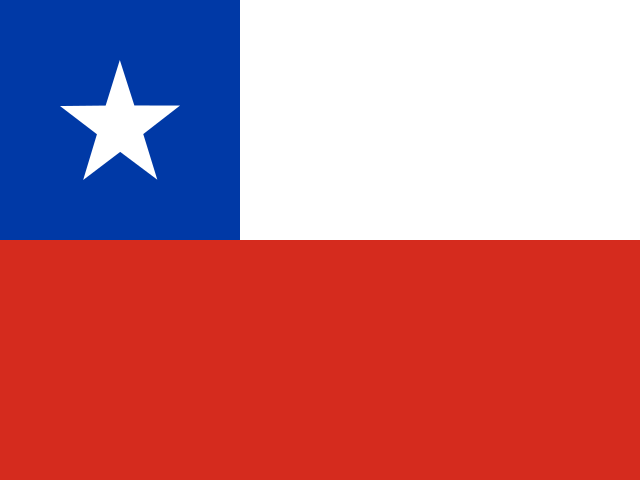
The Quechua are a diverse group of long-established Andean peoples, such as the Chopcca, the Chanka and the Q'ero, among many others. They live mainly in Peru, Bolivia and Ecuador, and also in Colombia, Argentina and Chile.
Quechua isn't a single language but a family of languages with many varieties. It probably began in the central Andes and spread before the Inca Empire; under the Incas it became the general language of Tawantinsuyu. Its speakers call it runa simi, “the language of the people”: runa means people or person, and simi means word, tongue or mouth.
It is an official language in Peru, where it predominates (art. 48 of the Constitution), and in Bolivia (art. 5); in Ecuador, Kichwa is an official language of intercultural relations (art. 2). Chile recognizes the Quechua as an indigenous people (Law 19,253).
3,735,682
people in Peru learned to speak Quechua as children: 13.9% of the population aged 5 and over (INEI, 2017 census).
5,176,809
Peruvians aged 12 and over identify as Quechua: 22.3% (INEI, 2017 census).
1,613,210
people in Bolivia learned to speak Quechua: 18.0% of the population aged 4 and over (INE, 2012 census).
Among the contributions of the Quechua peoples, Peru's Ministry of Culture highlights farming terraces (andenes), the chaquitaqlla foot plow, textiles and huayno music.
Quechua also lives on in everyday Spanish: cancha, papa, choclo, palta, cóndor, pampa, quinua, llama and puma all come from Quechua, and so does the word “quechua” itself, from qichwa, “temperate valley”. In English, condor, puma, llama, pampas and quinoa came through Spanish from Quechua too.
Why a Quechua name
Because it says exactly what we do, and because it's a word from the region where we started.
We're not a Quechua company and we don't speak for the Quechua peoples: we use the word with respect for what it means. We spell it ruway, one of its variants; in Cusco it's also written ruray.
How we work
- We work with Unitree robots and with other brands, depending on what each project needs.
- We state in writing what's autonomous, what's a programmed routine and what's teleoperated.
- We don't arm robots, we don't patrol public streets and we don't switch on facial recognition by default.
- We publish our reference prices and the data we use, with dates and sources.
Sources
Wiktionary, «ruway» · Julio Calvo Pérez, Nuevo diccionario quechua-español, vol. 1 (Academia Peruana de la Lengua, 2022) · Ministerio de Cultura del Perú, DDC Cusco: glosario básico quechua (2025) · Ministerio de Cultura del Perú, BDPI: lengua quechua · Ministerio de Cultura del Perú, BDPI: pueblos quechuas · INEI, Censos Nacionales 2017 · INE Bolivia y UNFPA, Censo 2012 · Constitución del Perú, art. 48 · Constitución de Bolivia, art. 5 · Constitución del Ecuador, art. 2 · Chile, Ley 19.253, art. 1 · Glottolog, familia quechua · RAE, Diccionario de la lengua española (etimologías)
Facts verified on October 14, 2026.
Let's get to know each other
Tell us about your project in a 30-minute call.
- Reply within 24 business hours
- Written quote, no commitment
- Deployments in the US and Latin America